
BLACKBOX · Versatile, engineered in collaboration with Sahas Labs
An autonomous testing lab, on your floor.
Sampling, specimen preparation, testing and reporting, run end to end without an operator carrying anything anywhere. Configured for green sand, or for metallography.
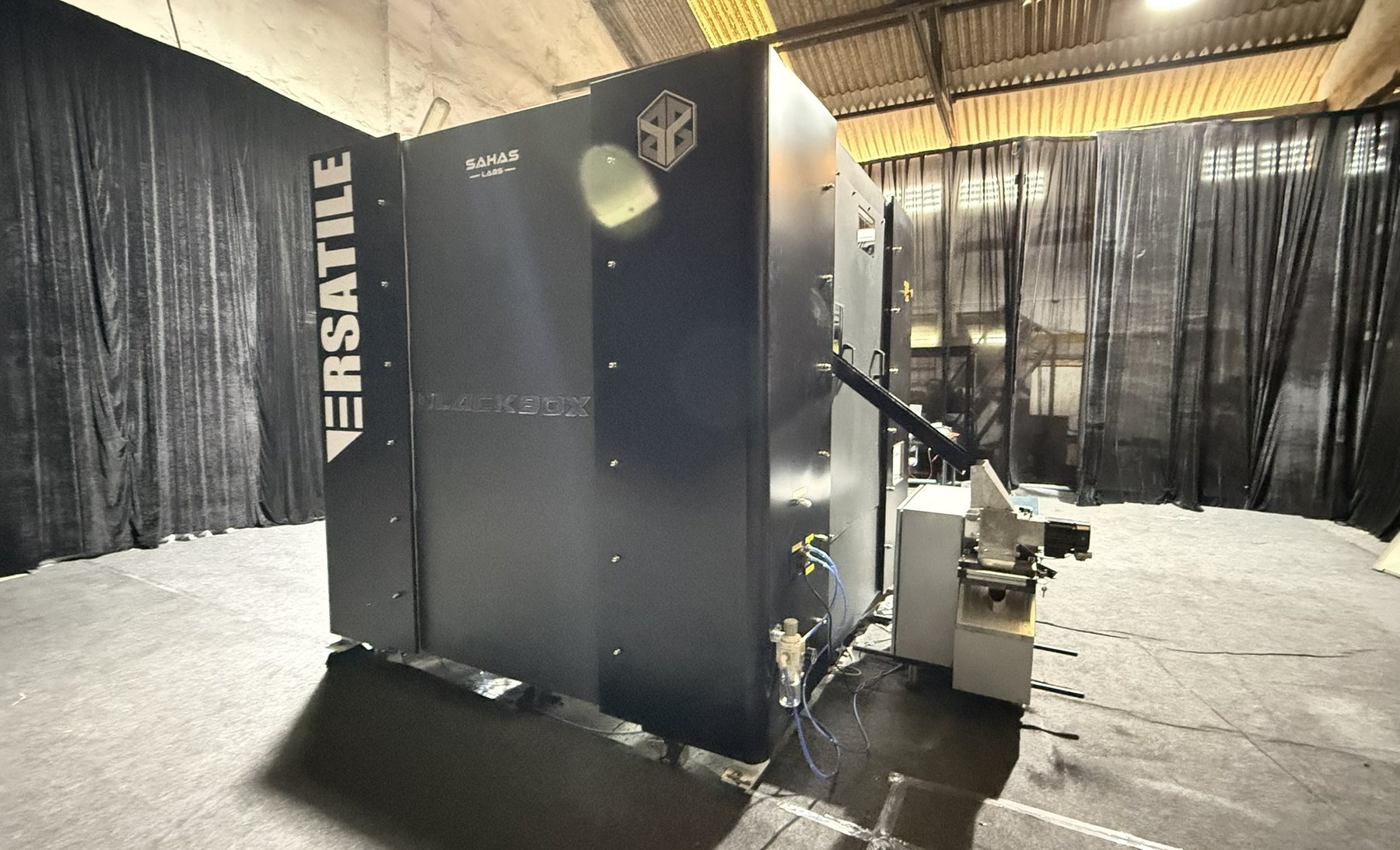
autonomous lab
Off-line equipment has no say in the mould being made now.
A sample is carried to the lab, rammed by hand, read by eye, written down, and typed up later. By the time the number exists, the sand it describes has been poured.
| How it works today | With BLACKBOX on the floor | |
|---|---|---|
| Test latency | An operator carries the sample to the lab. 20 to 45 minutes from mould to result. | Tested at the line. The result arrives in seconds rather than tens of minutes. |
| Operator variance | Manual rammer strokes, and microstructure graded by eye. | An automated, repeatable cycle. Specimen preparation stays consistent across operators and shifts. |
| Data capture | Handwritten logs, retyped into spreadsheets. No timestamp integrity. | Captured digitally at source with trusted timestamps. Nothing is re-keyed. |
| Correlation | Sand data and defect data sit in separate systems. Root cause takes days. | Both land in the same model, so the question can be asked in minutes. |
The physics behind the latency is well documented. An AFS Basic Concepts Committee (4-E) study across five foundries found that with muller-discharge moisture and temperature held constant, compactability was still lost in transit. Seal the sand in an airtight bag and it still falls, so nothing has evaporated: water is migrating into the interior platelets of the clay, and the absorption continues for roughly two and a half hours after the batch leaves the muller.
shown
Handling, seeing and deciding, with nobody in the loop.
Three moments from the machine at work. No commentary, no music, and nothing staged for the camera.
The cell moves the sample
A robot arm works the preparation and test stations, so the specimen is never carried by hand.
The specimen is identified
Machine vision confirms the specimen and the gripper state before the cycle continues.
The trend is read, not just logged
Compactability tracked against target, with recommended actions and an optional route back to the PLC.
Clips are from an engineering record of the machine in build. They are shown to demonstrate specific functions rather than as a finished installation.
One enclosure, configured for the lab you actually run.
The tests are chosen by you, and so is how often each one runs.
Green sand, no-bake and resin coated
Everything a V-CAT measures at the line, plus the bench tests that normally wait for the lab.
- Compactability, moisture, permeability and strength
- Active clay, volatile matter and loss on ignition
- Specimen preparation to 50 mm dia x 50 mm, or 2 in x 2 in
- Compression, tensile and transverse from prepared sand
- Or any other test of your choice
Microstructure and spectro
Automated sample preparation with image analysis, for the metallurgical side of the same problem.
- Nodularity and nodule count
- Phase fraction and graphite class
- Automated grinding, polishing and imaging
- Spectrometer of your choice integrated
Choose what matters, and how often it runs.
Tests are configured per installation. This is what the platform covers today.
- Sieve analysis, with sieve cleaning
- Compression strength
- Time-domain compression for no-bake
- Active clay, with analysis
- Permeability
- Moisture, by dry and weight method
- Gas evolution
- Loss on ignition
- Wet tensile strength
- Hot distortion
- Compactability
- Acid demand value and pH
- Tensile strength
- Transverse strength
- Specimen preparation and weighing
Samples reach the machine automatically from the process where that is practical, or they are fed in by hand. Self-cleaning routines cover the internals, the specimen tube, the sieves, and waste redirection to a designated outlet.
demonstrable
It exists. You can come and watch it run.
The unit in these photographs is assembled, plumbed and running its cycle at Kolhapur. The fastest way to judge whether it belongs in your plant is to stand in front of it.
Bring your own sand. We would rather it were tested on yours than on ours.

integration
Results land where your process data already lives.
A reading that stays inside the instrument is a reading nobody acts on.
| On the machine | Tablet-based interface with guided workflows, live status, alarms and user access control |
|---|---|
| To your cloud | V-Sync synchronises readings to your account on sandtesting.org, or to a local server |
| To your plant | Registers itself with your plant systems over the usual industrial links, with no manual setup |
| To the twin | Pre-integrated with Sahas Forge, so test schemas are predefined and results share the same time series as furnace, moulding and gateway data |
| Away from the plant | Monitoring from a phone or any PC, with per-user authentication and alerts by email or SMS |
| Traceability | Time-stamped records for batch, sample identity, recipe, results and alarms; exportable reports |
we quote
Tell us what you test, and how often you wish you could.
A BLACKBOX is configured around a test list and a sampling point, not picked off a shelf.
- Which sand system, and which tests matterGreen sand, no-bake or resin coated, and the tests you actually act on
- How often each test should runPer batch, per shift or on demand; this sets the cycle and the consumables
- Where the sample comes fromAutomatic extraction from the process where practical, or fed by hand
- Whether metallography is in scopeMicrostructure and spectro change the configuration substantially
- Where the results should landV-Sync cloud, a local server, an existing SCADA, or the Sahas Forge twin

IATF 16949Certified