


Sieve analysis, from grains to a number.
Sieve analysis turns a handful of sand or powder into a particle-size distribution, and in the foundry into a single grain fineness number. Here is how it works, and how to choose the sieves that make the number trustworthy.
What sieve analysis is
A weighed sample is placed on the top sieve of a nest arranged coarse to fine, with a receiver at the bottom. The nest is agitated, each sieve retains the grains too large to pass its aperture, and the mass held on every deck is weighed. Those masses, read as percentages, are the particle-size distribution.
Reading the distribution
The retained masses convert to percent retained and cumulative percent passing. Plotted against aperture, they draw the grading curve, and the aperture at which half the sample has passed gives a median size. The shape of the curve tells you whether a material is tightly graded or spread across many sizes.
Grain Fineness Number, worked through
The AFS GFN weights the percentage retained on each sieve by a multiplier for that sieve, sums the products, and divides by the total percentage retained. A finer sand carries more mass on the fine decks, so it earns a higher number.
| Sieve | % retained | Multiplier | Product |
|---|---|---|---|
| 425 µm | 4 | 20 | 80 |
| 300 µm | 12 | 30 | 360 |
| 212 µm | 27 | 40 | 1080 |
| 150 µm | 31 | 50 | 1550 |
| 106 µm | 18 | 70 | 1260 |
| 75 µm | 6 | 100 | 600 |
| Pan | 2 | 140 | 280 |
Illustrative worked example. Sum of products 5210, divided by total percent retained 100, gives an AFS GFN of about 52. The sieve analysis follows AFS 1105-12-S, and the multipliers follow AFS 1106-12-S. For the full method and background, see the guides below.
The same number, without the arithmetic.
Everything above can be done at the bench. The Grain Size Calculator VAFS-I does it in one pass: weigh each screen and it computes the AFS grain fineness number on the spot. Paired with VSync, the traceable report writes itself.
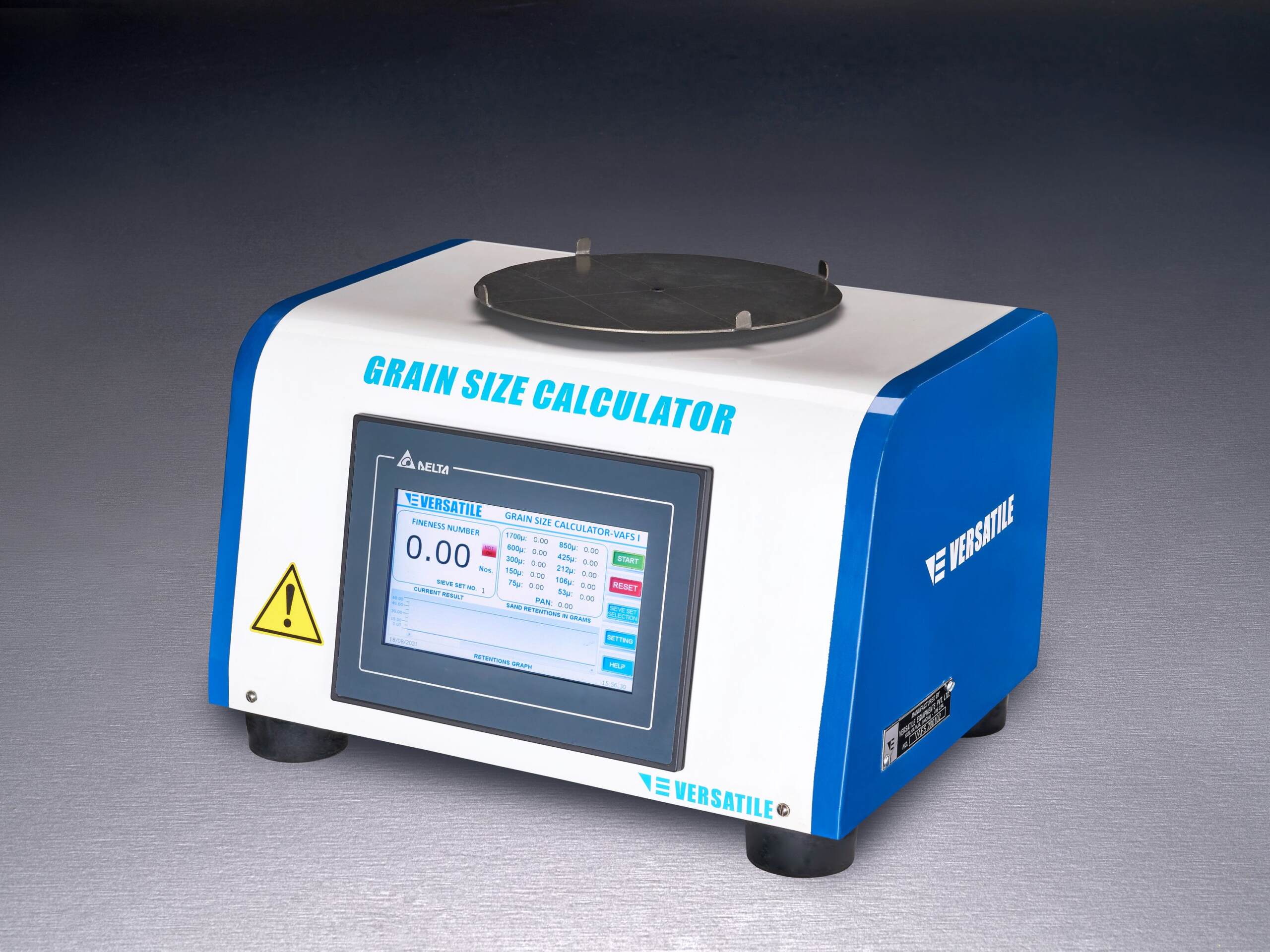
- Place each sieve on the platformThe retained sand is weighed in place, screen by screen, to 0.01 g.
- Read the fineness number, liveThe HMI applies the AFS multipliers and shows the number as the screens are entered.
- VSync files the reportA numbered, branded report per sample, with lot, truck and invoice traceability.
- The result goes to the cloudEach fineness number is logged, ready to trend by supplier, lot or shift.
Weigh before you clean.
The retained sand is weighed on the sieve, in place, before anything is cleaned. Grains are not pushed to the next cut by a brush, so the weights are truer. And because the mesh is never brushed, sieves are cleaned by ultrasonic instead, which keeps the weave inside tolerance and extends how long each sieve holds its certificate.
Truer weights
Retained sand is measured on the sieve, in place, to 0.01 g. No grains are pushed to the next cut by a brush, so the numbers reflect what the screen actually held.
Longer sieve life
Cleaning moves to ultrasonic instead of brushing. The certified weave keeps its aperture, and holds its certificate, for longer.
Operator-independent
The balance reads and the HMI computes the AFS number. The same method, and the same result, shift after shift.
Report and trend
A numbered, traceable report per sample, filed by VSync. Fineness tracks by supplier, lot or shift, so drift shows up before a casting does.
Retained percentage across the ASTM screens. This sample forms a clean single peak at 70 mesh, with most of the sand held on the 50, 70 and 100 screens, which is what a well-graded medium sand looks like at GFN 61. VSync draws this the moment the last screen is weighed.
Aperture, grade and shake.
Match the material
Bracket the size range you expect with enough decks to see the shape of the curve, not just its ends. For foundry sand, the AFS series is the accepted set.
Match the stakes
Compliance for routine QC, inspection for audited method work, calibration for reference sieves and referee testing. Compare the grades.
Make it repeatable
A timed mechanical shaker reduces the operator’s influence on the result, so the distribution is the sample's, not the analyst's.
Compliance, inspection or calibration grade?
How often should a working sieve be re-certified?
Do you certify sieves you did not manufacture?
Wet or dry sieving?
The nest this method needs
Ready to specify a set?
Send the material and the standard you report to. We will propose the apertures, the grade and a shaker to match, and quote for delivery worldwide.