

Digital Active Clay TesterThe endpoint, seen.
Not guessed.
The VMBD runs the full AFS 2211-17-S methylene-blue test on its own and photographs the dye halo after every addition, so the endpoint is read from an image instead of from wet paper at the bench. About ten minutes, walk-away.
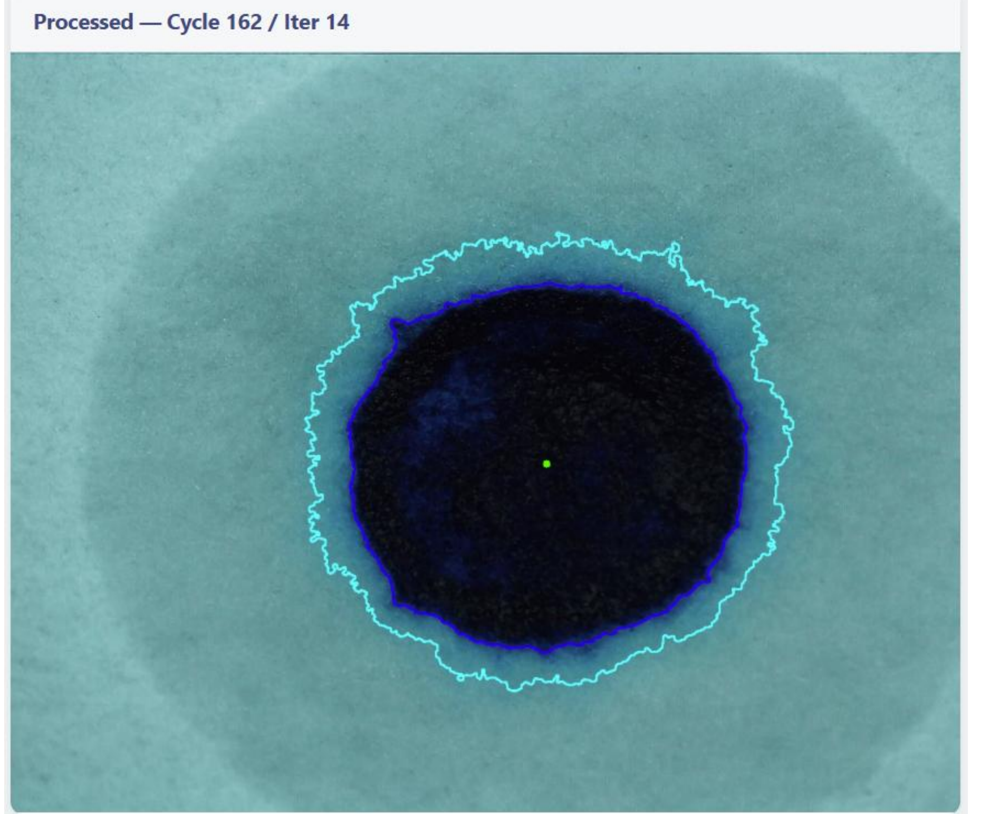
It was never the chemistry. It was the eye.
In the manual test an operator adds dye drop by drop and judges a blue “halo” on filter paper. The endpoint is a matter of eyesight, and two technicians can read two numbers, each titration ties up a trained hand, and the result lags the moulding line.
Active clay is the figure that bentonite is dosed against: it sets green strength, mould rigidity and the defect rate. Over-adding wastes bentonite; under-adding lets mould strength collapse. A number this important should not depend on who ran the test.
The chemistry was never the difficult part. Reading a faint blue halo by eye, shift after shift, is where the number moves.
It watches the halo grow, addition by addition.
Heat, cool, stir, titrate, and then a camera images the dye halo after every addition. Those images are reviewed on a phone or laptop over the instrument’s own WiFi, so the endpoint is read from a picture rather than from wet paper under changing light. With the VMBD-AI licence the endpoint is called automatically and the result appears on the touchscreen.
Prep & Start
Add the sample and press Start. Heating (80 °C / 3 min → 40 °C), cooling and stirring run on their own.
Titrate
Methylene-blue solution is dosed in steps at a fixed least count (1 mL), recipe-controlled (AMC001).
See the halo
After each dose the halo is imaged and measured: core → in progress → complete.
Self-stop & log
The test ends at absorption-complete and writes the full iteration record: image, width, mL, time.
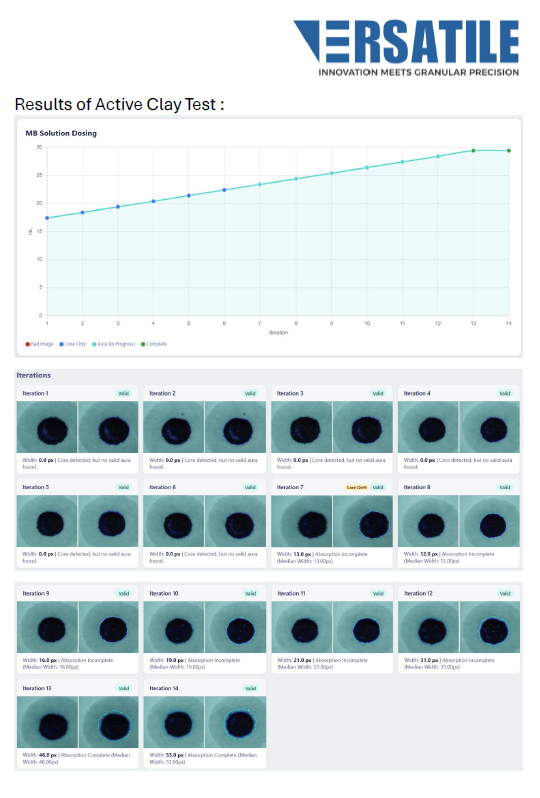
Every result carries its own evidence.
The dosing curve shows methylene-blue added against iteration; each point is classified from the analysed frame. Below it, all fourteen iterations are kept, with the measured halo width in pixels and an Absorption Complete verdict at the endpoint.
No hand-written numbers. No “trust me.” A record the quality system, and the customer’s auditor, can inspect, synced to the cloud through V-Sync.
From a reading to a decision that holds up.
The same run that images the halo also puts the result in the language a quality system uses: a spec verdict, a recipe tied to the material, and a calibration record on the machine.
A spec band, live on the screen.
Set a lower and upper active-clay limit for the process, and each result reads in-spec or out-of-spec as it finishes. The shift gets a go/no-go decision, not a number to interpret.
Calibrated to the bentonite in use.
Different bentonites take up methylene blue differently. Build a recipe for each bentonite type, each with its own calibration curve, and store it. Switch grades in a tap, and the reading reflects the material on the line.
It carries its own calibration status.
Calibration date, due date and serial number sit on the instrument, set against a known standard, the same identity the calibration certificate can verify by QR.
The halo can be read by software instead.
Every VMBD photographs the filter paper after each addition and sends the image to a phone or laptop over its own WiFi. An operator normally looks at that image and decides when the halo has formed. VMBD-AI reads it instead, using a model trained on filter papers from real foundry sands, so the endpoint is called the same way whoever is standing at the machine.
The camera and the WiFi hotspot are already inside every VMBD, so nothing is fitted and the instrument does not come out of production. One licence covers one instrument, held against its serial number.
What the licence changes.
| VMBD as supplied | With VMBD-AI | |
|---|---|---|
| Endpoint call | An operator reads the image and decides when the halo has formed | The software reads the image and calls the endpoint |
| Between operators | Two people can read one picture and report two figures | Arrived at the same way each time |
| Late in a shift | The same person can read the image differently | The same image gives the same reading |
| The test run | Heat, cool, stir, titrate, image every addition | Run exactly as before |
| What is fitted | Camera and WiFi hotspot already inside | Nothing added, no wiring disturbed, no downtime |
| How it is supplied | Included with the instrument | One perpetual licence per instrument, against its serial number |
The same measurement, for drilling fluids.
Methylene blue capacity is called for outside the foundry as well. With one additional dosing tank the VMBD can be built to run the methylene blue capacity determination to API RP 13I and ISO 10416, with the endpoint determined in the same way.
This is specified when the unit is built rather than added later, so it is worth mentioning at the enquiry stage if testing to those standards is planned.
Same standard. Different century.
| Manual MB titration | Versatile VMBD | |
|---|---|---|
| Endpoint | Operator eyeballs the halo at the bench | Imaged every addition, read on screen. Automatic with VMBD-AI |
| Repeatability | Operator-dependent | Everyone judges the same stored image |
| Time / test | Slow; ties up a technician | ~10 min, walk-away |
| Skilled labour | Trained titrator required | Prep & press Start |
| Data | Hand-written | Wi-Fi hotspot + V-Sync cloud |
| Standard | AFS 2211-17-S | AFS 2211-17-S, automated |
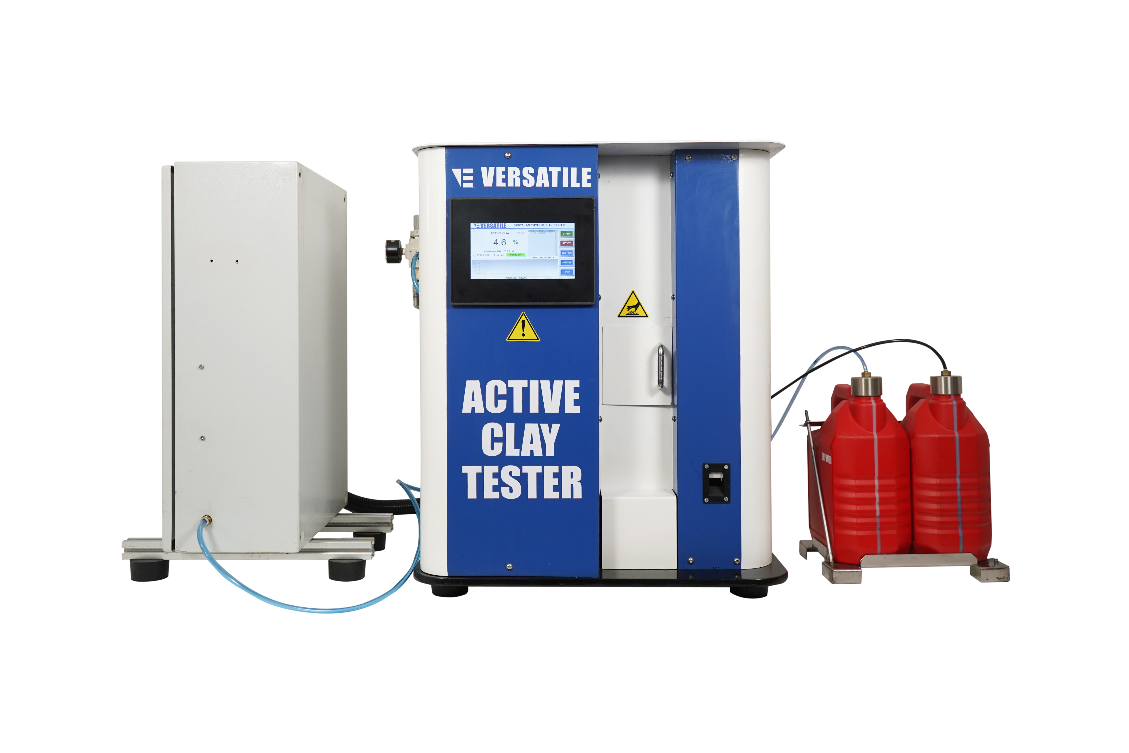
Lab-grade hardware, shop-floor simple.
- Add the sample, press Start, with close to zero operator input
- Heating, cooling, stirring and dosing, all electronic
- On-board Wi-Fi: read results on a phone or PC
- V-Sync cloud sync for audit-ready records
- Full per-iteration image & data log for traceability
| Test | Active clay (bentonite), green sand |
|---|---|
| Method | AFS 2211-17-S |
| Range | 3-20% active clay |
| Endpoint | Halo imaged each addition, read on screen. Automatic with VMBD-AI |
| Cycle | ~10 min, walk-away |
| Data | Wi-Fi · V-Sync cloud |
See it run on your sand.
Book a demonstration, or ask for sample results and a quotation. We will show the VMBD running a test on green sand from the line, and the record it leaves behind.