
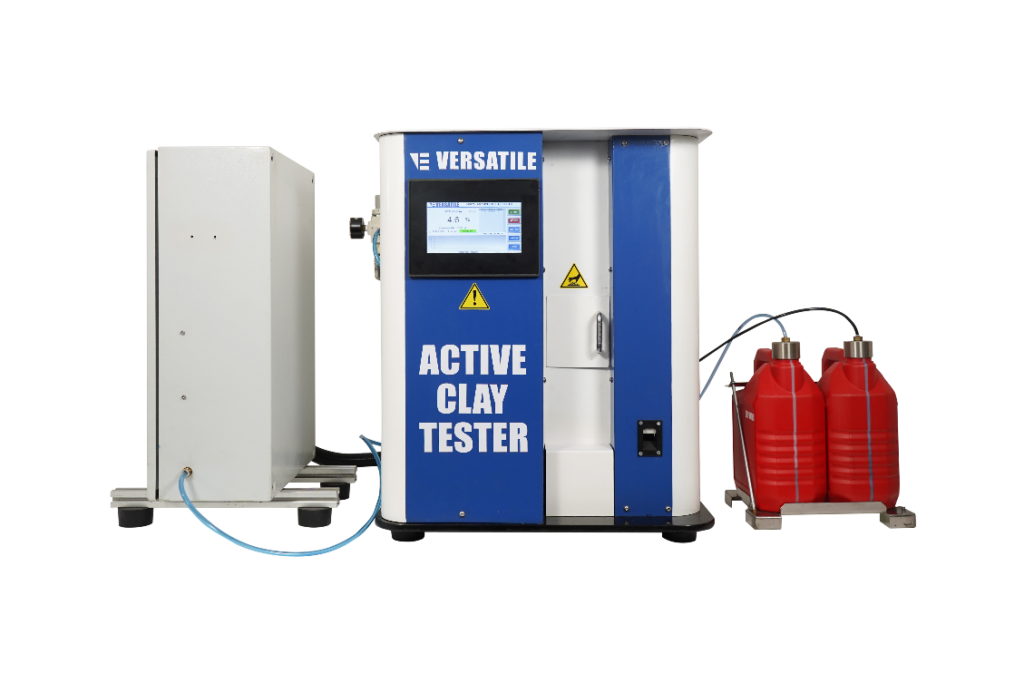

VMBD Digital Active Clay Tester
The Versatile VMBD Digital Active Clay Tester automates the AFS 2211-17-S methylene-blue test and photographs the halo after every addition, giving an active-clay reading (3-20%) in about 10 minutes, walk-away, read on a phone or laptop over on-board Wi-Fi with V-Sync cloud records. Automatic endpoint with the VMBD-AI licence.
Prefer email? Write to [email protected] and mention this model.
Technical specifications
See how it works: watch the active-clay test in action on our VMBD active clay tester feature page.
The Versatile VMBD automates the active-clay (bentonite) determination in green sand. Instead of an operator adding methylene-blue dye drop by drop and judging a blue “halo” by eye, the VMBD runs the complete AFS 2211-17-S methylene-blue clay test on its own and photographs the halo after every addition, so the endpoint is read from an image on a phone or laptop rather than judged at the bench. With the VMBD-AI licence the endpoint is determined automatically and the result appears on the instrument touchscreen.
Why active clay matters
Only the active clay develops bond, so it sets green strength, mould rigidity and the casting-defect rate, and it is the figure you dose bentonite against. Over-add and you waste bentonite and hurt compactability; under-add and mould strength collapses. The measurement therefore has to be right and repeatable.
How it works: the halo, imaged
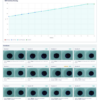
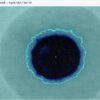
The VMBD heats, cools and stirs the sample, then titrates methylene-blue solution while a camera images the dye halo on the filter paper after each addition. Those images are reviewed on a phone or laptop, where each iteration can be seen as core only, halo in progress or absorption complete. With the VMBD-AI licence the software classifies them and calls the endpoint itself. Every step is logged with its image, so the result is fully auditable.
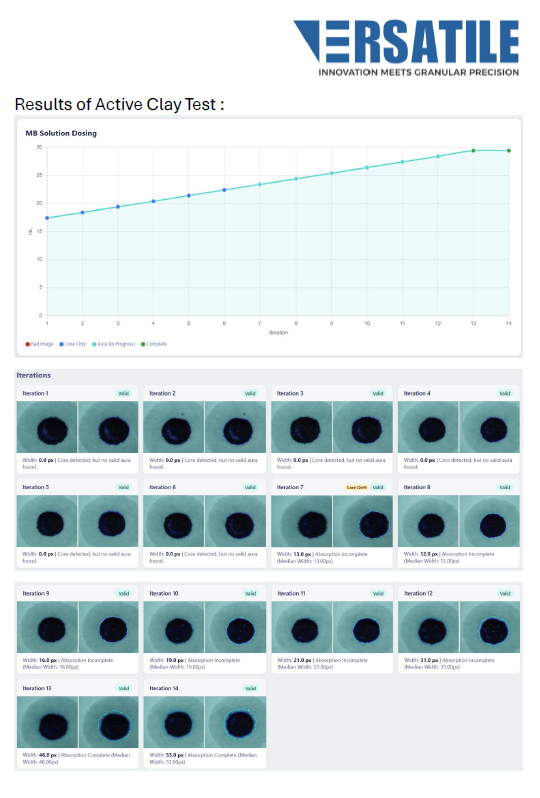
Proof you can audit
Each test produces a complete record: the recipe used, heating and cooling profile, titration least count, and the analysed halo for every iteration with its measured width in pixels. No more hand-written numbers or two technicians reporting two different endpoints.
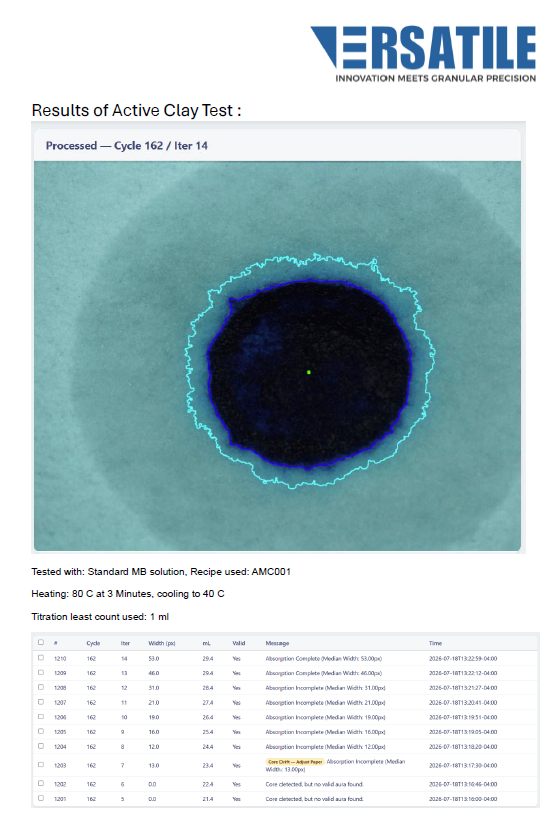
Manual methylene-blue titration vs. the Versatile VMBD
| Manual MB titration | Versatile VMBD | |
|---|---|---|
| Endpoint | Operator eyeballs the halo | Halo imaged every addition, read on screen. Automatic with VMBD-AI |
| Repeatability | Operator-dependent | Everyone judges the same stored image |
| Time per test | Slow; ties up a technician | ~10 min, walk-away |
| Skilled labour | Trained titrator required | Prep & press Start |
| Data | Hand-written | On-board Wi-Fi hotspot + cloud sync (V-Sync) |
| Standard | AFS 2211-17-S | AFS 2211-17-S, automated |
Built for the quality lab, not just a reading
The VMBD is set up to sit inside your quality system, not beside it:
- Your spec band, on the screen. Set a lower and upper active-clay limit for your process, and each result reads in-spec or out-of-spec as it finishes: a go/no-go for the shift, not a number to interpret.
- Calibrated to the bentonite you run. Different bentonites take up methylene blue differently, so the VMBD stores a recipe for each bentonite type, each with its own calibration curve. Switch grades in a tap and the reading reflects the material on your line.
- Carries its own calibration status. Calibration date, due date and serial number sit on the instrument, set against a known clay standard by a two-point or multi-point routine, the same identity a Versatile calibration certificate can verify by QR.
On the touchscreen
The colour HMI runs the whole test and keeps the data with it. A recipe library holds a named method per material; the timed steps (boiling, stirring, dosing, dot-hold and result-wait) run the same way each cycle, and methylene blue is metered by a precision pump in fine increments. Results are logged with date and time and trended on-board, next to a running cycle count. Guided prompts and position interlocks (home, beaker and flask sensing) keep the sequence safe, and the unit is networked over Wi-Fi with cloud sync through V-Sync.
Readings, in the cloud with VSync
This model works with VSync web sync, so results are logged and stored online. A supervisor can review a shift from a browser, and a service engineer can look at the same data remotely. See how VSync works →
Read up before you buy.

Bring this instrument into your lab.
Tell us your sand types and what you test, and we will quote the right configuration and any attachments.