

V-CAT · Versatile Inline Controller and Tester
VCAT2 tests the sand that actually reaches the mould.
In-line testing at the moulding machine. Compactability, moisture, permeability and mould strength in 12 to 22 seconds, with set-point feedback to a compatible mixer control system and mould rejection on your own control limits.
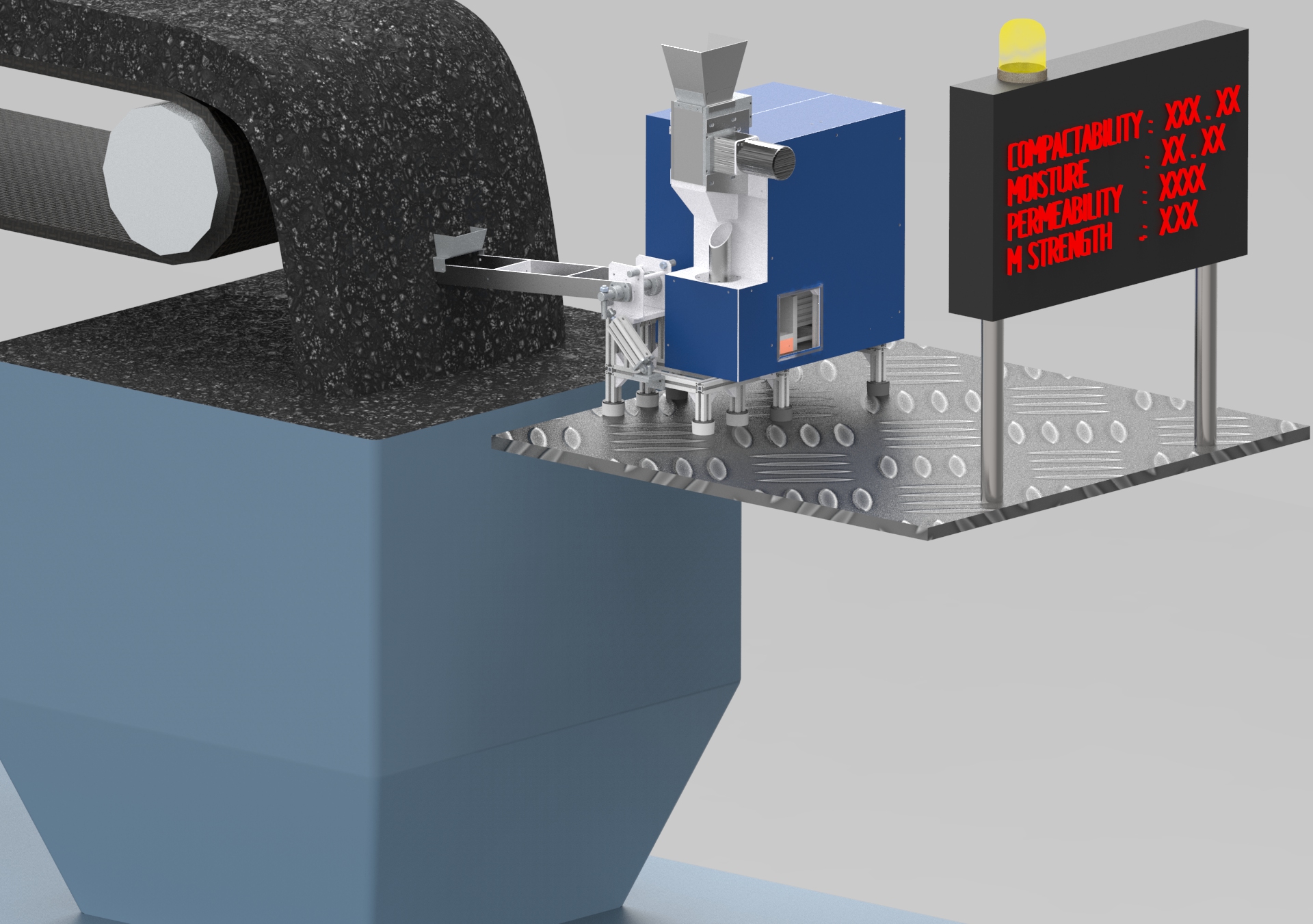
Simulated readout, shown at speed. Real cycle 12 to 22 s.
Compactability is controlled at the mixer. It changes on the way to the mould.
Five things move it between mixing and moulding, and every one of them varies through a shift.
Time delay
Line stoppages leave sand waiting, and it keeps changing while it waits.
Mixer to moulding
The longer the route to the moulding machine, the further the sand has drifted on arrival.
Sand temperature
Mixing raises sand temperature, which changes how water and clay behave downstream.
Air temperature
Shop temperature varies with the time of day and with the season.
Humidity
Ambient humidity moves alongside it, and the sand follows both.
The sand is already varying before it leaves the mixer
Eight inputs feed every batch. A mixer set-point holds against their combined effect, not against any one of them.
- Return sand temperature variation
- Return sand moisture variation
- Return sand active clay, or bentonite, content variation
- Change of pattern and bunch weight
- Effect of ambient temperature on sand properties
- Effect of mixer condition and maintenance
- Water dosing flow rates, and water availability
- Sand silo change, altering the sand going into the mixer
can test
Four parameters from one automatic sample.
Sand going into the moulding machine is sampled and tested on a fully automatic, logic-based cycle. No operator, no bench, no human intervention.
Compactability
Squeezing type
The primary control parameter, and the one the mixer set-point is corrected against.
Estimated moisture
Electrical properties correlated to show estimated moisture
Taken from the same sample, so a moisture drift appears in the same cycle as the compactability it explains.
Mould permeability
Adds to the cycle time
Included when gas defects are what you are chasing, and left out when cycle speed matters more.
Strength
Mould strength, penetration type, or green compression strength
Specified to match how your control plan already defines strength. Green compression strength is measured on a non-standard specimen tube, so ask us how it compares against your bench figures.
Readings are stored for later analysis and retrieval. An optional input device lets the moulding operator select the current pattern, so each reading is recorded against a pattern number.
after the test
The result does not go into a logbook. It goes into the plant.
Each test ends in an action, inside the same cycle.
Display and alarm
The result posts to the board at the machine. On a control-limit crossing it hoots and flashes, so the moulder and the supervisor both know.
Feedback to the mixer
Set-point adjustment is sent immediately to the mixer compactability controller, where that control system is a compatible one.
Mould rejection
A marking I/O output fires against your LCL and UCL. The digital output can be wired into the sand plant to reject sand or bypass moulding automatically.
Readings synced
Every reading syncs to your account on sandtesting.org, or to a local server we supply, for later analysis and retrieval.
deploy it
Five variants, from one tester to the whole plant.
The family runs from a single tester above a moulding machine through to a plant with both control loops closed. Select a component to see where it sits.
| Variant | Where it sits | What it tests | What it drives |
|---|---|---|---|
| VCAT1 | Above the moulding machine | Compactability and moisture | Hooter, beacon and the mould rejection output. Testing only, no corrections. |
| VCAT2 | Above the moulding machine | Compactability, moisture, permeability and strength | Alarm, set-point feedback to the mixer, and mould rejection on your LCL and UCL |
| VCAT3 | At the mixer | Compactability alone, which is what keeps the cycle short | The mixer compactability set-point, and V-DOSE water dosing |
| VCAT4 | At the mixer | The fuller parameter set | Set-point and V-DOSE, with V-HOP hopper sensing and batch hopper temperature correction |
| VCAT5 | Across the plant | Both positions running together | Both loops, plus V-COOL cooler control and a centralized SCADA server |
V-DOSE
Precision water dosing at the mixer, and the actuator the compactability loop actually moves.
4.2 lps · accuracy plus or minus 100 ml
An alarm is raised when pump performance drops away or flow rates dwindle.
V-HOP
Moisture and temperature sensing in the mixer’s batch hopper.
Needed where the next batch is corrected from the previous batch’s result, since the hopper reading is what the correction is calculated against.
V-COOL
Moisture and temperature sensing at the cooler, with nozzle control.
Sand temperature is uploaded to SCADA against a compactability-loss table, so compactability at the point of use holds as return sand temperature moves.
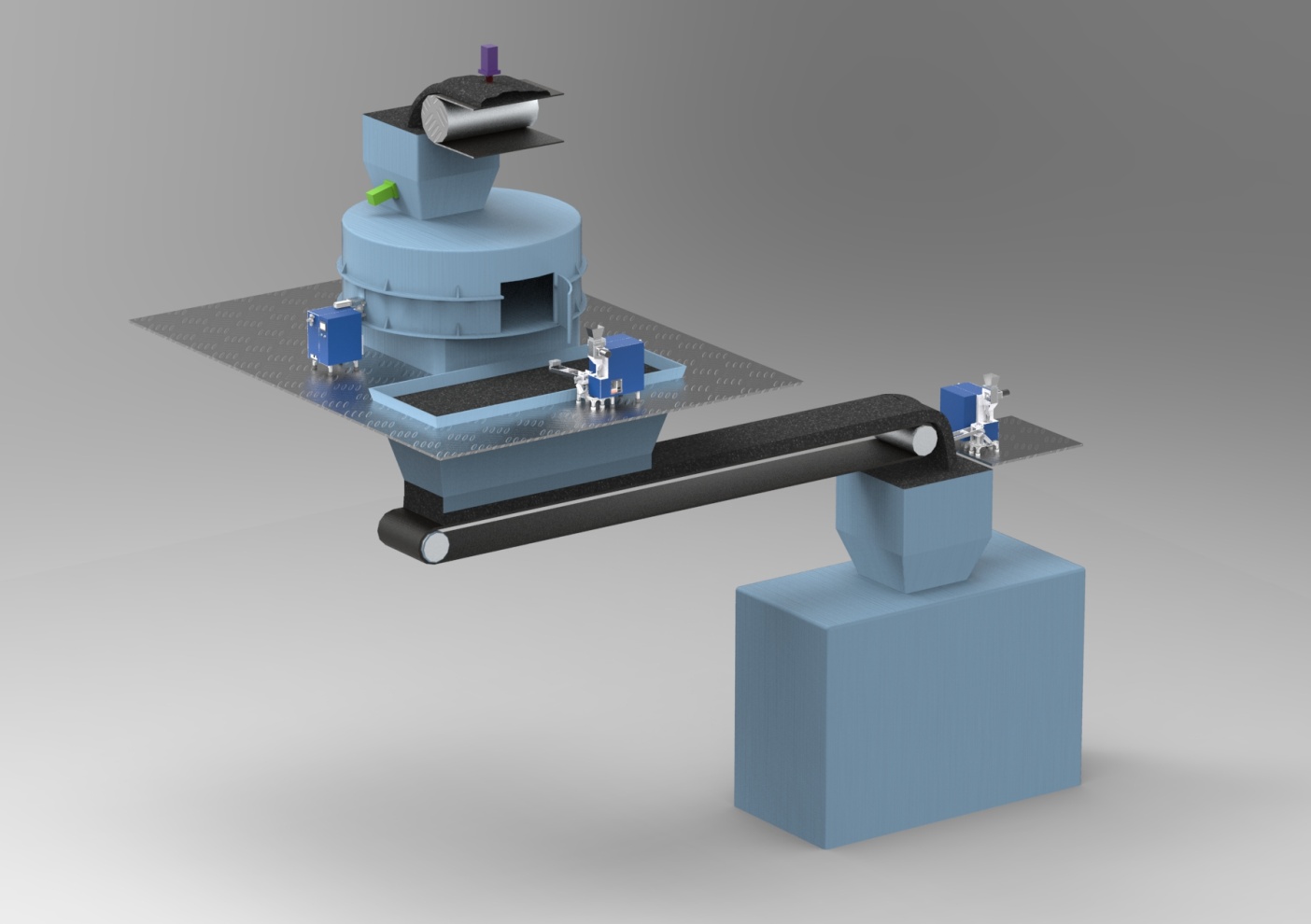
An 80 TPH Disa sand plant, running a 3 MT mixer.
The schematic and the render above are how it is drawn. This is one of them at work.
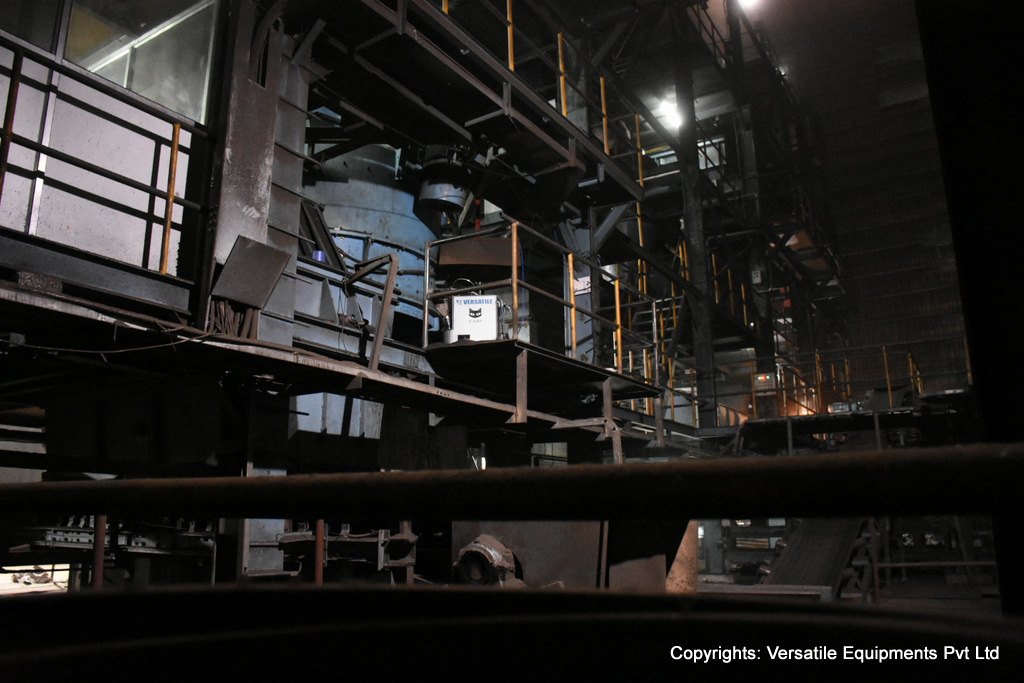
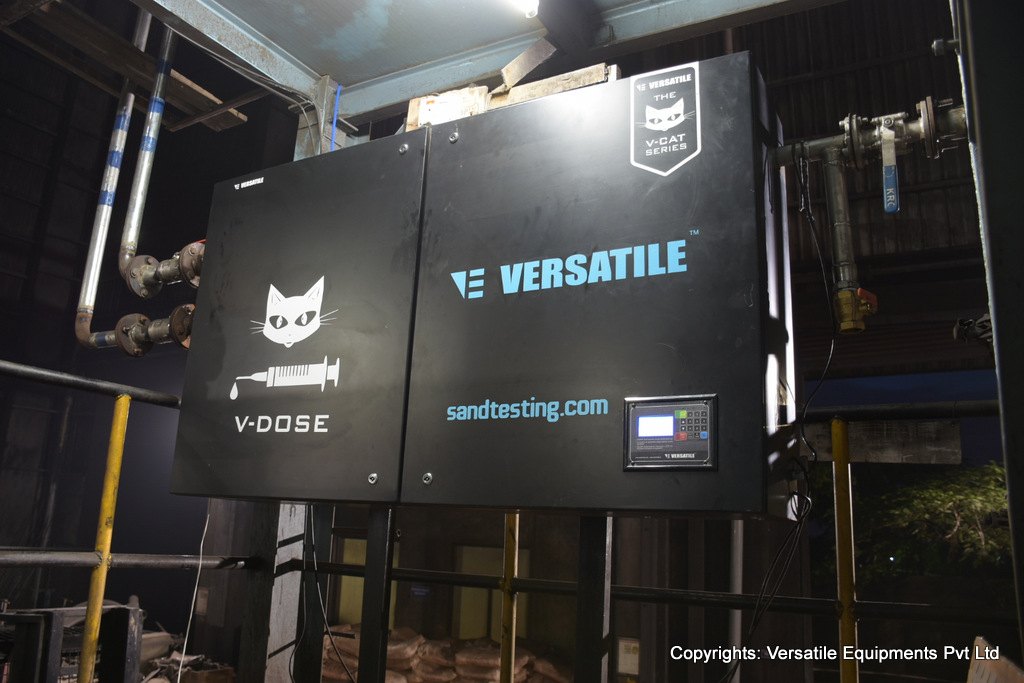
The white cabinet on the platform at centre is the V-CAT unit, at the mixer module where the compactability set-point is corrected. A second unit above the moulding machine chute closes the other loop. Photographs are of a customer installation and remain the property of Versatile Equipments Pvt Ltd.
and data
Every reading is kept, wherever you want it kept.
A LAN links all the systems, which keeps communication fast and straightforward. Where the readings land is your decision.
- V-Sync cloud synchronisationReadings sync to your account on sandtesting.org, or to a local server we provide
- SCADA, storing readings locallyOptional, where everything is better kept inside the plant
- LAN switch and routerSupplied as part of the system
- Pattern number inputUpdated from an optional input device at the machine
- Monitoring away from the plantFrom a phone, or any PC inside or outside the LAN
- Alerts that reach peopleEmail from your own address, and status alarms by SMS
- User-specific authenticationAccounts and authorities set per user

VCAT2 at a glance.
| Tests | Compactability (squeezing type); estimated moisture (electrical properties correlated to moisture); mould permeability; strength, as mould strength of the penetration type or green compression strength on a non-standard specimen tube |
|---|---|
| Typical testing time | 12 to 15 s without permeability; 15 to 22 s with permeability |
| Test frequency | As frequent as every mould, cope and drag separately where they are made separately; the user can set it lower |
| Sampling | In-line automatic sampling of sand going into the moulding machine, on a fully automatic logic-based cycle |
| Attachment | Sand grabber and aerator, for placing the unit above the moulding machine |
| Alerts | Results displayed, with hooter and flashing light on a control-limit crossing; limits verified pattern-wise |
| Control outputs | Set-point adjustment feedback to a compatible mixer compactability controller; mould-rejection marking I/O based on LCL and UCL; digital output to reject sand or bypass moulding |
| Data | V-Sync sync to sandtesting.org or a local server; SCADA local storage optional; LAN networked |
| Pattern tracking | Pattern number updated from an optional input device, so readings are recorded against the pattern |
| Positions | VCAT2 at the moulding machine, testing four parameters; VCAT3 at the mixer, testing compactability alone on a shorter cycle |
we quote
Tell us about the line, and we will size the system to it.
A V-CAT installation is scoped against your plant rather than picked off a shelf. Five things get us most of the way.
- Moulding machine make, and moulds per hourSets the test frequency the system has to keep up with
- Mixer make and control systemDecides whether set-point feedback can be accepted directly
- Compactability target, and the spread you actually holdYour LCL and UCL become the rejection limits
- Return sand temperature, and whether a cooler is fittedDecides whether cooler water flow control belongs in scope
- Where the readings should landV-Sync cloud, a local server, an existing SCADA, or a combination
Built and serviced by Versatile
V-CAT is designed, manufactured and supported in Kolhapur, by the same people who make the lab instruments most Indian foundries already run. Installation, commissioning and calibration are handled by our own engineers.
IATF 16949Certified